
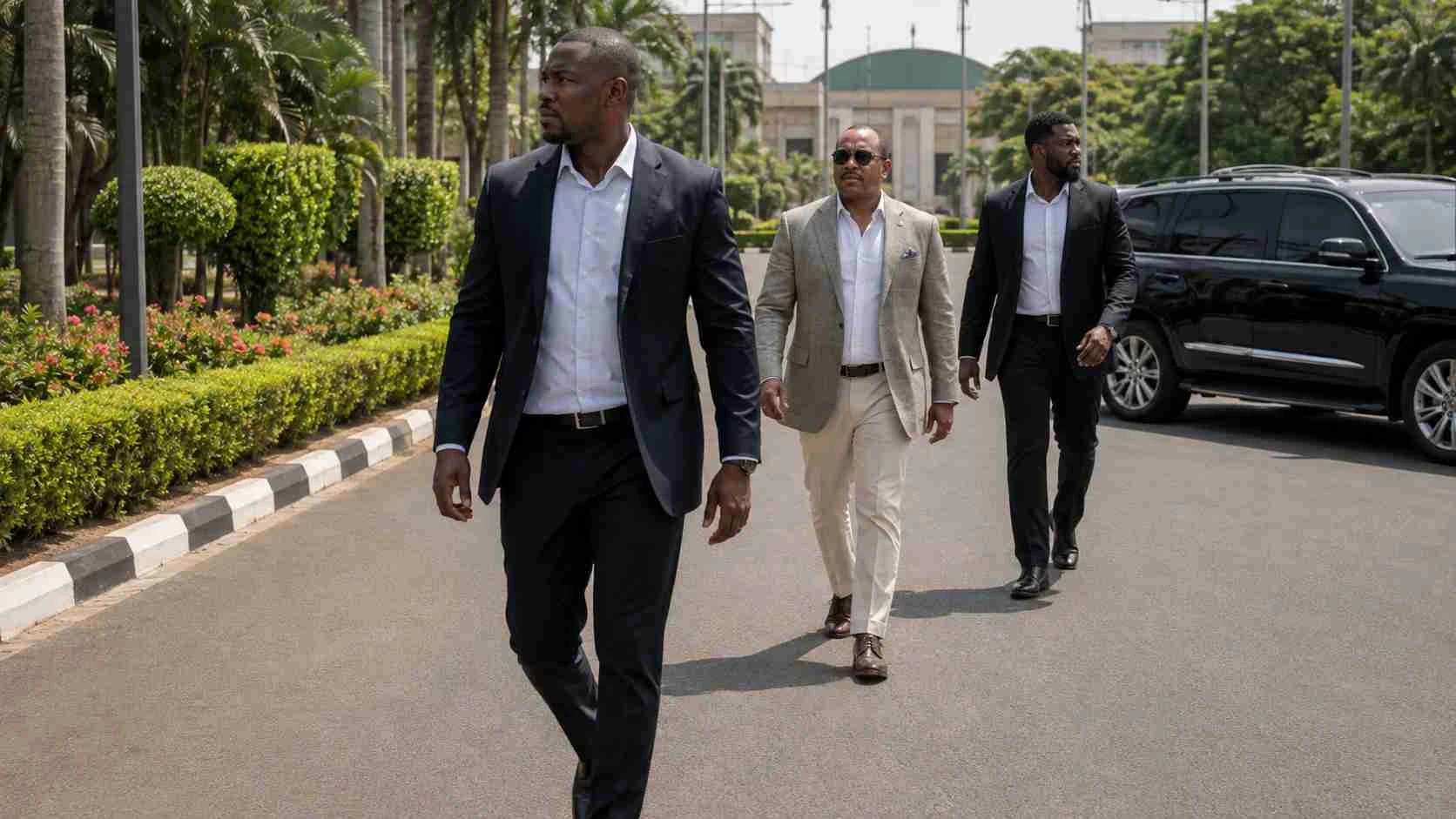
ABUJA · EXECUTIVES · DELEGATIONS · FORMAL & PRIVATE PROGRAMMES
Bodyguard Services in Abuja for Executives, Diplomats & Families
R&H Global Protection coordinates bodyguard and executive protection services in Abuja for executives, private families, corporate and diplomatic delegations, and international visitors. Planning can connect Nnamdi Azikiwe International Airport (ABV) with Maitama, Asokoro, Central Business District appointments, compounds, hotels and hosted functions, with dedicated drivers and any separately required local or public-security support defined in advance.
Part of R&H Global Protection’s bodyguard services in Nigeria and international protection capability.
R&H Global Protection — Abuja Bodyguard Services at a Glance
Nnamdi Azikiwe International Airport (ABV)Executive & delegation protection
Principal-focused coverage for business leaders, formal visitors and delegations around the accepted Abuja programme.
Private family support
Personal protection around residences and family commitments, with fixed property duties staffed separately where required.
ABV & dedicated driving
Airport receiving, luggage and the driver are coordinated with the first Maitama, Asokoro or CBD responsibility.
Nigeria continuity
Longer Abuja work and onward Nigerian stages are planned with realistic staffing, relief and receiving arrangements.
Hiring & Planning
Can You Hire a Private Bodyguard in Abuja?
Yes. R&H Global Protection can coordinate private bodyguard and executive protection in Abuja for a defined corporate, delegation, family or retained programme. The brief should identify dates, principals, ABV arrival, Maitama or Asokoro commitments, accommodation or compound requirements, and whether dedicated drivers or additional resources are needed. The Nigerian provider and private-security roles are verified for the assignment; any public-security element is treated separately.
For an initial Abuja quotation, provide dates or approximate duration, protected people, the main arrival or meeting point, and whether a dedicated driver, residence team or parallel coverage is required.
Private Bodyguard · Executive Protection · Close Protection in Abuja
What Does a Bodyguard in Abuja Actually Cover?
An Abuja bodyguard stays focused on the named principal through the agreed working period, connecting airport reception, vehicle movement, formal appointments, private accommodation and hosted functions. The officer’s role is personal protection; the receiving organisation, compound or event keeps control of its own premises and access procedures.
Driving, fixed property guarding and any public-security or armed support are separate functions. R&H Global Protection can coordinate those resources when the assignment calls for them, but the proposal identifies which entity and personnel perform each Nigerian role rather than presenting them as one generic bodyguard package.
Abuja Protection Planning
Executive Protection in Abuja for Formal Visits & Private Commitments
Executive protection in Abuja begins with the purpose of each appointment and the people who need accompaniment. A delegation visiting several hosts may need more than one personal officer, while a single executive can require a quieter arrangement around meetings and private time. Clear communication with the authorised assistant keeps those responsibilities aligned as the programme changes.
Personal coverage follows the client’s accepted schedule. Embassy, ministry, compound and venue teams retain control of their own premises and procedures; the protection detail coordinates with them rather than implying official authority.
The actual host comes first
Government-facing, diplomatic and corporate visits can involve different receiving organisations. The client contact should identify the actual host and permitted accompaniment. An officer’s presence must support the appointment without implying official status or replacing the host’s screening responsibilities.
Personal coverage within a delegation
A delegation vehicle does not automatically provide personal protection for every passenger. Establish who needs individual coverage, whether members separate and which assistant coordinates changes. Staff the protected people rather than simply dividing the headcount by the seats available.
A quieter family or residence role
An executive’s family may follow a separate programme from the formal visit. Personal accompaniment, household privacy and fixed residence duties need their own boundaries. Discuss those needs before allocating an officer entirely to the principal’s meetings.
Arrival, appointments and the final return
An ABV arrival, fixed meetings and an evening reception can form one extended requirement. The proposal defines officer duty and driving separately. A later domestic flight or road continuation needs fresh receiving arrangements, not an open-ended promise from the original airport booking.
Abuja Protection Services
Close Protection in Abuja: Personal and Supporting Services
Build your Abuja protection arrangement from distinct personal and supporting services. The options below connect the client’s priorities with the right officer, preparation and additional resources; the agreed proposal identifies what is included.
Executive bodyguard in Abuja
Principal-focused support for executives, advisers and investors attending offices, institutional meetings and private hospitality. Preparation follows the client’s stated concerns and public visibility. The assigned officer works with the assistant while keeping the purpose of confidential appointments appropriately controlled.
Delegation and Diplomatic-Visit Support
Personal coverage can be arranged for named delegates attending hosted appointments in Maitama, Asokoro and the capital’s business district. Identify separate meeting schedules early so officers and vehicles are allocated appropriately. Invitations and accompanying-personnel access remain subject to the host’s procedures.
ABV arrival and departure protection
Include the booked Nnamdi Azikiwe airport movement in the agreed personal-protection window. Flight, party, luggage and the first fixed appointment guide the receiving plan. Premium assistance, protocol services and restricted terminal access require separate confirmation rather than being implied by a bodyguard booking.
Security driver and executive vehicle
A separately assigned driver can support ABV, Maitama, Asokoro and central appointments while the officer remains focused on the client. Specify passengers, waiting, the expected finish and any onward journey. Vehicle readiness and personal accompaniment must not become incompatible tasks for one person.
Family and child protection
Arrange discreet accompaniment around private residences, hotels and family commitments. Parents and carers keep their normal roles. When children, a partner or other protected relatives follow different programmes, a separate officer may be needed rather than stretching the executive’s personal coverage.
Conference and private-event protection
Support a speaker, guest or host through the agreed event programme. Discuss public visibility, organiser communication and permitted accompaniment before attendance. Personal protection does not automatically include crowd management, guest screening, perimeter staffing or general security for the whole event.
Female bodyguard requests
A female protection officer can be requested for a private client, family preference or specific accompaniment need. Outline the dates, relevant experience and communication requirements. Proposed personnel, professional suitability and the lawful local role are confirmed before the arrangement is treated as available.
Residence and Compound Coordination
A longer Abuja stay may combine mobile personal protection with independent residence duties. Establish the household or compound contact, the hours requiring property coverage and how visiting staff are handled. The mobile officer should not be counted as a fixed post while accompanying the client elsewhere.
Protective Advance and Host Liaison
Preparation connects the principal’s exposure and disclosed concerns with host communication, appropriate accompaniment and a workable daily plan. Agree who receives changes and how significant incidents or decisions are reported. The process supports the client without promising priority access to controlled premises.
Retained protection and Nigeria continuity
Build recurring executive or family support around personnel matching, an introduction and a named management contact. Define duty, relief and review arrangements. Travel to Lagos, Port Harcourt or another Nigerian city is separately assessed for staffing, transport, accommodation and receiving responsibilities.
Client Profiles
Who Uses Bodyguard Services in Abuja?
Clients seeking protection in Abuja have different professional, family and private needs. The arrangement follows the people requiring coverage and the activities they undertake, including any schedules that run independently.
Executive visitors
Business leaders attending federal-capital meetings and private hospitality.
Hosted delegations
Named principals with assistants, receiving organisations and possibly separate appointments.
Diplomatic visitors
Clients whose legitimate hosts control compound entry and formal visit procedures.
Investors and advisers
Principals handling confidential discussions across institutional and business settings.
Private households
Families needing discreet accompaniment as well as clearly separated residence support.
Conference speakers
Guests with public-facing event commitments and private time outside the venue.
Family-office representatives
Contacts arranging personnel preferences, recurring support and limited information sharing.
Multi-city travellers
Clients combining Abuja with a separately planned Nigerian domestic-air or road stage.
Israeli-led planning · Assignment-specific delivery
Protection Planning Adapted to Abuja
Abuja planning begins with the actual host structure. R&H Global Protection identifies the principal, who controls each meeting or compound, how the client moves from ABV, and where private family or residence responsibilities sit outside the formal programme.
Advance work focuses on receiving contacts, vehicle responsibility, access expectations, communication with the client representative and any transition between private-security personnel and separately authorised public-security support. The aim is clarity before the principal reaches the first appointment.
For longer or multi-city Nigerian assignments, the team revisits driver hours, residence needs, delegation splits and the next receiving location. Israeli-led planning informs the protection concept, while Nigerian licensing and any public-security approvals remain specific to the actual delivery model.
Abuja Local Context
Abuja Protection Around Formal Hosts, Compounds & Private Life
Your Abuja base, appointments and private commitments shape the detail. These local settings explain where the officer’s preparation, host communication or supporting resources may need to change.
Maitama and the receiving organisation
Private appointments and formal visits can require different levels of advance communication even within the same area. Work from the actual receiving contact and the client’s permission to share information. A district name is useful context but does not establish who may accompany a visitor inside.
Asokoro and residence-based programmes
A residence or compound may have its own guarding, visitor records and household procedures. A mobile personal officer should understand those interfaces without being silently assigned the gate. Family members leaving on separate plans can require additional personal coverage as well as transport.
Central meetings and conferences
A corporate appointment followed by an advertised speaking engagement changes the principal’s exposure. The assistant and organiser help define accompaniment and timing. Venue screening belongs to the organiser; the bodyguard’s personal duty can extend to the client’s agreed private commitments outside the event.
ABV and onward Nigerian travel
The airport phase should be connected to the booked appointment programme and realistic officer and driver hours. A domestic departure, delayed arrival or onward road request can change the allocation of resources. Record the final responsibility point instead of assuming indefinite airport-to-airport availability.
The actual host comes first
Personal coverage within a delegation
Nnamdi Azikiwe International Airport (ABV)
Conferences, hosted receptions and private dinners.
Lagos, Port Harcourt and other declared Nigerian destinations.
The final plan uses your confirmed properties, hosts and programme. Additional destinations and specialist requirements are reviewed before they are included in the Abuja assignment.
The Assigned Team
Professional Standards for Your Abuja Detail
Abuja assignments work best when formal-host liaison, private-client protection and transport responsibilities are explicit. R&H Global Protection coordinates the international brief while the Nigerian provider, personnel and any separately approved public-security resources are confirmed for their own roles.
R&H Global Protection is led by former Israeli Special Forces and Shin Bet professionals and applies a prevention-focused methodology to Abuja. Local delivery is structured around Nigerian requirements, the client’s hosts and clear separation between private personal protection, driving, fixed guarding and public-security functions.
The officer must work comfortably around corporate, diplomatic and institutional hosts while respecting that each premises controls its own entry and security.
A mobile bodyguard cannot simultaneously remain at a residence gate. Fixed property duties are staffed separately when the principal leaves.
Private-security delivery is confirmed through the appropriate Nigerian provider and roles before the assignment is accepted.
Any police or other public-security component requires its own approval and command relationship; it is not implied by hiring a private officer.
Airport receiving, driver responsibility, luggage and the first protected appointment are planned as one controlled handover.
When principals attend different meetings, additional officers and vehicles are considered instead of stretching one detail across simultaneous commitments.
Hiring a Bodyguard in Abuja
How to Arrange Close Protection in Abuja
Define the principals and hosts
State who requires protection and whether the programme is corporate, diplomatic, private-family or mixed.
Confirm the ABV arrival
Provide flight timing, party size and the first hotel, residence or hosted commitment so receiving can be planned.
List Maitama, Asokoro and CBD stages
Broad appointment areas and host types help separate premises-controlled security from the client’s personal detail.
Add compound or family requirements
Explain whether the residence stays staffed and whether family members move independently while the principal attends meetings.
Review Nigerian delivery roles
Confirm the private provider, officers, drivers and any separately approved public-security component before mobilisation.
Approve hours and national continuation
Set the duty window, price, expenses and any Lagos, Port Harcourt or other Nigerian stage in writing.
An early ABV arrival followed by two formal appointments and a late reception requires more than a vehicle booking. The written scope should distinguish the principal’s officer, the dedicated driver and any other protected delegation members. A host’s visitor approval does not remove the need to agree working periods and local delivery.
Abuja Service Models
Choose the Right Protection Model in Abuja
Select the model around your Abuja priorities: the people needing protection, the duration and the responsibilities that must run at the same time. Each proposal identifies personal coverage, additional support and a realistic working pattern.
- Capital-city executive visit A defined personal detail for one principal’s Abuja appointments and private commitments.
- Officer with dedicated driving Separate personal protection and vehicle responsibilities across ABV and the confirmed city programme.
- Delegation with parallel meetings Officers allocated to protected principals who separate, with transport sized independently.
- Recurring executive or family support For recurring Abuja visits or a longer residence-based assignment, agree a consistent officer profile, office or household introduction, duty pattern and relief. Periodic reviews account for new hosts, changing family needs and travel to other Nigerian cities, with additional costs confirmed before the scope expands.
- Residence plus mobile detail Distinct fixed property staffing where required while the personal officer follows the principal.
- Abuja and onward Nigeria A continuing client brief with newly agreed local resources and receiving arrangements at the next destination.
Abuja Bodyguard Cost · Written Quotations
How Much Does a Bodyguard in Abuja Cost?
R&H Global Protection’s indicative Abuja planning range is USD 700–1,500 per officer per day. The final proposal depends on the protected principals, ABV receiving, driver and vehicle resources, formal-host programme, residence requirements, duty hours and any separately approved public-security or onward Nigerian support.
Flight timing, first destination, formal appointments, evening commitments and the point where the Abuja duty ends.
The number of protected people and any simultaneous meetings that require another personal officer.
Passenger capacity, luggage, waiting, city movement and realistic driver hours across the accepted programme.
Advance liaison needed for Maitama, Asokoro, CBD or hosted functions, without taking over the host’s own security.
Separate property staffing, family movements, relief and retained coverage where a longer private requirement exists.
Onward travel, accommodation, repositioning, taxes, payment and cancellation conditions for the complete accepted scope.
Team Configurations for Abuja Protection
These configurations describe different responsibilities, not interchangeable price packages. The proposal identifies the actual people, working periods and supporting resources included.
The officer range does not automatically include a driver, vehicle, additional preparation, travel, accommodation or separate property coverage. The written breakdown identifies included duties, supporting expenses and applicable tax treatment for the actual requirement.
Confirm the Abuja service window, dates and any longer travel or event duties before committing. Extra personal coverage and driver waiting are different cost items and should remain visible in the proposal.
Request the Abuja quotation for the complete requirement so personal protection, transport, concurrent duties and any regional or international stage are priced against the same operating picture.
Confirm payment, mobilisation, cancellation terms and what is excluded before booking. An enquiry does not reserve personnel until the commercial and operational scope is accepted.
Request Your Abuja Bodyguard QuoteLocal and Regional Coverage
Personal Security in Abuja and Your Onward Itinerary
Abuja coverage is planned around the accepted programme through ABV, Maitama, Asokoro, the Central Business District and the client’s accommodation or compound. Lagos, Port Harcourt or another Nigerian destination is a distinct stage with its own personnel, transport, receiving and duty-hour review.
Abuja
R&H Global Protection treats Abuja as a host-and-handover environment. The key planning points are airport reception, vehicle responsibility, formal premises, private accommodation and the boundary between personal protection and any separately controlled public-security resource.
The actual appointments and private requirements accepted in the proposal.
The booked gateway, personal receiving duty and separately defined transport.
Personal accompaniment and any independent property-security requirement.
Named principals and organiser permissions, not automatic whole-event security.
Fresh receiving contacts, resources and working-period review for subsequent stages.
These official sources support the regulatory or event context described above. They do not certify a proposed operator. Confirm the current provider, individual permissions and host instructions for the actual assignment; event attendance remains subject to the relevant organiser’s rules.
Why R&H Global Protection
Why Choose R&H Global Protection in Abuja?
R&H Global Protection gives Abuja clients one management line for an assignment that may involve formal hosts, private-family requirements, drivers and separate Nigerian delivery roles. The programme is designed around clear responsibilities rather than vague promises of an all-purpose security team.
Host-aware executive protection
Formal appointments are planned around the receiving organisation’s access rules while the officer remains focused on the principal.
Israeli-led preventive planning
Former Israeli Special Forces and Shin Bet leadership informs preparation, awareness and disciplined client communication.
ABV and dedicated-driver integration
Airport receiving connects directly to the vehicle and first responsibility point instead of treating transport as an afterthought.
Private and public roles separated
Private bodyguards, drivers, residence staff and any approved public-security resource are identified separately in the scope.
Nigeria multi-city continuity
Abuja can continue to Lagos or other accepted destinations with fresh receiving, staffing and transport decisions.
Transparent contracting
The proposal identifies people, hours, exclusions, logistics, pricing and the Nigerian delivery structure before mobilisation.
“I was based in Abuja for three weeks while helping establish a new business partnership. My working hours were unpredictable, so we discussed the likely demands and agreed the coverage before I arrived. What I valued was not having to give the same instructions every morning. The team worked well with our office coordinator, respected the confidentiality of my meetings and kept me informed without constantly interrupting. It was a reassuring arrangement during a demanding assignment.”
Published company experience · R&H leadership and operating approach · Editorial standards and accountability
International Protection Continuity
Continue Protection from Abuja Across Nigeria and Beyond
Abuja assignments can continue to Lagos, another African business centre or an international destination. R&H Global Protection can preserve the client brief and management expectations while the next location receives its own provider, personnel, transport and legal review.
Nigeria and Africa:
Lagos, Nairobi, Cape Town, Marrakech.
International continuation:
Dubai, London, Paris.
More protection destinations:
Monaco, New York, Madrid, Zurich, Milan.
Abuja · Confidential Protection Enquiry
Hire a Bodyguard in Abuja
For Abuja, send R&H Global Protection the dates, protected principals, ABV arrival, broad Maitama/Asokoro/CBD programme, accommodation type and whether drivers, fixed residence coverage or separately approved public-security support may be needed. Sensitive host and threat details can follow through the agreed private channel.
WhatsApp opens a draft for you to review and send. Opening it does not book protection or reserve personnel. Prefer a web form? Use our contact page.
Abuja Bodyguard Questions
Frequently Asked Questions About Protection in Abuja
Answers on Abuja bodyguard costs, hiring, arrivals, transport, local delivery, family or event requirements and longer protection programmes.
How much does a bodyguard in Abuja cost?
R&H Global Protection’s indicative Abuja planning range is USD 700–1,500 per officer per day. Final pricing depends on duty hours, principals, ABV receiving, drivers, vehicles, residence needs and any separately approved support.
What does executive protection in Abuja include?
Executive protection in Abuja can include personal accompaniment, ABV reception, advance planning, host liaison and secure movement between Maitama, Asokoro, the CBD, hotels and compounds. Driver and property roles are separately scoped.
Can an officer accompany a visitor to a ministry or embassy?
Yes, if the ministry, embassy or host permits the officer to accompany the principal. Accreditation, screening and restricted access remain under the host’s control.
How is a delegation different from a single-principal booking?
A delegation may need multiple officers, drivers and coordination because several principals can move separately. A single-principal booking is built around one protected person and one core schedule.
Can I request a dedicated security driver in Abuja?
Yes. R&H Global Protection can coordinate a dedicated security driver and suitable vehicle. The driver handles movement while the bodyguard stays focused on the principal.
Can you arrange long-term family protection in Abuja?
Yes. Long-term family protection in Abuja can be arranged with defined duty hours, relief, introductions and management. Separate compound or simultaneous family duties may require additional personnel.
Can a female bodyguard or a particular working language be requested?
Yes, subject to availability and local eligibility. Tell R&H Global Protection the preferred gender, working language and role so the assigned profile can be confirmed before deployment.
How is the local delivering arrangement checked for Abuja?
R&H Global Protection checks the proposed Nigerian provider, personnel and private-security roles for the actual assignment. Any police or other public-security support is treated as a separate approved function.
Are protection officers in Abuja armed?
R&H Global Protection’s private Abuja detail is planned as unarmed unless a lawful separate arrangement is confirmed through the appropriate local structure. Armed or public-security support is not included automatically.
Can Abuja protection connect to Lagos or Port Harcourt?
Yes. Abuja protection can connect to Lagos, Port Harcourt or other Nigerian stages once travel, receiving arrangements, drivers, accommodation and local delivery are confirmed.